|
 |
|
|
|
Sustainable
Rural Infrastructure Provision
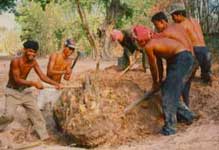 The use of locally available labour, skills, technology and materials has proven to be an effective and economically viable approach
to rehabilitation and maintenance of rural infrastructure by local government institutions.
In addition, by ensuring the full involvement of the local construction industry, allows
governments to rely on in-country resources and reduce its use of imported goods and services,
thereby boosting local economies and increasing employment opportunities.
The use of locally available labour, skills, technology and materials has proven to be an effective and economically viable approach
to rehabilitation and maintenance of rural infrastructure by local government institutions.
In addition, by ensuring the full involvement of the local construction industry, allows
governments to rely on in-country resources and reduce its use of imported goods and services,
thereby boosting local economies and increasing employment opportunities. |
|
Today, this
approach has been effectively utilised to improve and maintain large road networks
and other rural infrastructure in Africa and Asia. |
|
 (BJEC) can provide a full range of expert
support to all stages of the project cycle, from formulation, implementation, monitoring
of outputs to final review and evaluation of rural infrastructure development programmes.
These services include:
(BJEC) can provide a full range of expert
support to all stages of the project cycle, from formulation, implementation, monitoring
of outputs to final review and evaluation of rural infrastructure development programmes.
These services include: |
|
 Appraisal and feasibility studies
 |
|
Planning
and programming |
|
Preliminary
and detailed design |
|
Cost
analysis and financial planning |
|
Technical
support to implementation of construction works |
|
Contract
management |
|
Training
needs assessments |
|
Design
and conduct of tailor-made training programmes |
|
Design
of effective, user friendly, planning, monitoring and reporting systems |
|
Design and operation of maintenance management systems |
|
Project supervision, review and evaluation |
|
Key
Qualifications: |
|
BJEC has more than 25
years of professional experience within the civil works sector. The majority
of this period has been dedicated to providing technical assistance to,
and managing infrastructure works programmes in Sub-Saharan
Africa, Asia and the Pacific. During these years he also participated actively in the development of the methodology for the increased involvement of the domestic construction industry in the implementation of infrastructure works. In addition to the ILO, he has collaborated with a number of international development agencies, such as UNDP, UNCDF, UNOPS, WFP, World Bank, African Development Bank, Asian Development Bank, Danida, DfID, NORAD, SIDA, NDF, and SDC. |
|
Development of training
programmes as well as conducting training, have been a central task in
several of the assignments. This has ranged from class-room
and on-the-job training to preparation of technical manuals and training videos
in subjects such as contracts management, labour-based road works technology
and rural road maintenance systems. |
|
 |
|
Project
Formulation:
Sustainable infrastructure provision in the rural areas is becoming increasingly accepted as an
important component of national development planning among international development agencies
and governments in developing countries. BJEC has extensive experience in
the preparation of project documents and agreements using established
formats required by the various international and national donor organisations. |
|
Implementation:
Establishing and expanding the use of local resources for infrastructure works through
local government and private sector involvement requires specialised skills and experienced personnel.
BJEC has acquired this experience from past assignments, covering both
design, planning, execution, management, training and evaluation of
works projects. In addition, BJEC maintains good working relationships
with other institutions which can provide complementary technical support
to such programmes. |
|
Contract
Management: Appropriate contract management
procedures are important to secure the effective involvement of the domestic construction industry. Furthermore, tools, equipment and materials needs to be procured in a timely manner,
applying transparent and accepted methods of contracting. BJEC has established
comprehensive experience in procurement methods, both for local competitive
bidding as well as for international competitive bidding. |
|
Training:
Training is vital for the successful transfer of technology,
thereby establishing the capacity within local authorities and their civil works institutions
to plan and execute works. Furthermore, the contents and quality of training programmes
determine the degree of sustainability of project investments. |
|
BJEC has participated
in a wide range of training activities: |
|
Detailed
training needs assessments |
|
Design
of training programmes for both public and private sector technical personnel |
|
Development
of training materials |
|
Design
of course programmes |
|
Implementation
of training courses, workshops and seminars |
|
The use of modern
training methods and equipment is important to ensure that training becomes
effective. BJEC has solid experience in these methods applying them both
in class-rom and practical on-site situations. |
|

 |
|
Road
Maintenance: Preventive maintenance is considered
a key element in achieving a cost-effective road management system. BJEC
has long experience in finding appropriate and economically viable solutions
for road maintenance in developing countries, ranging from major
highways to rural access gravel roads where emphasis is given to the use
of locally available resources and labour-based work methods. |
|
Review
and Evaluation: In order to assess the effects and achievements
of public works programmes, review and evaluation is an important activity
in the project cycle. BJEC has participated in a number of evaluation
missions where careful attention was given not only to main factors such
as physical outputs and productivities, but also to project sustainability,
gender and environmental issues, secondary effects on local markets and
industries, and the role the project plays in relation to the overall goals
of the government within the civil sector. |
|
Finally, the
review phase is often an opportune occasion to assess further demands
for external technical and financial assistance. |
|
Design
Tools: BJEC
delivers its services using common market standard computer equipment and software,
ensuring compatibility with the systems used by clients. All assignments
are supported with a portable, high-powered computer, thereby providing on-the-spot high
quality products before leaving the country. These tools are complemented with high-resolution
scanning and printing equipment available back in the home office. |
|


|
|
BJEC has provided
technical and managerial advisory services and training to
infrastructure work programmes in Africa, Asia and the Pacific.
From previous assignments, BJEC possesses working experience in: |
|
Afghanistan, Bangladesh,
Botswana, Cambodia, China, East Timor,
Ghana, India, Indonesia, Kenya, Laos,
Lesotho, Malawi, Mozambique, Myanmar, Namibia, Nepal, Nigeria, Pakistan, Philippines, Sierra Leone, Solomon Islands, Sri Lanka, Tanzania, Thailand, Uganda, Vanuatu, Vietnam, Zambia and Zimbabwe. |
|
 |
|
BJEC is a division
of Scanserve Ltd, a limited company, registered in Thailand with Bjørn
Johannessen as the Managing Director, and main provider of the above mentioned
services. |
|
|